
State of the Art Surgical Management of Metastatic Carcinoma of Unknown Primary of Head and Neck
Downloads
Published
How to Cite
Issue
Section
License
Copyright (c) 2019 Emilio Criollo, Enrique Benites, Diego A Zambrano, Kimberly Triviño, Celina Velasco

This work is licensed under a Creative Commons Attribution-NonCommercial-ShareAlike 4.0 International License.




DOI:
https://doi.org/10.33821/283Keywords:
NEOPLASM METASTASIS, NEOPLASMS, UNKNOWN PRIMARY, HEAD AND NECK NEOPLASMS, POSITRON-EMISSION TOMOGRAPHYAbstract
Purpose of the review: the objective of the review is to delineate the role of Surgical Management of primary metastatic carcinoma of the head and neck. We look for reports on indications, possible findings and subsequent treatments.
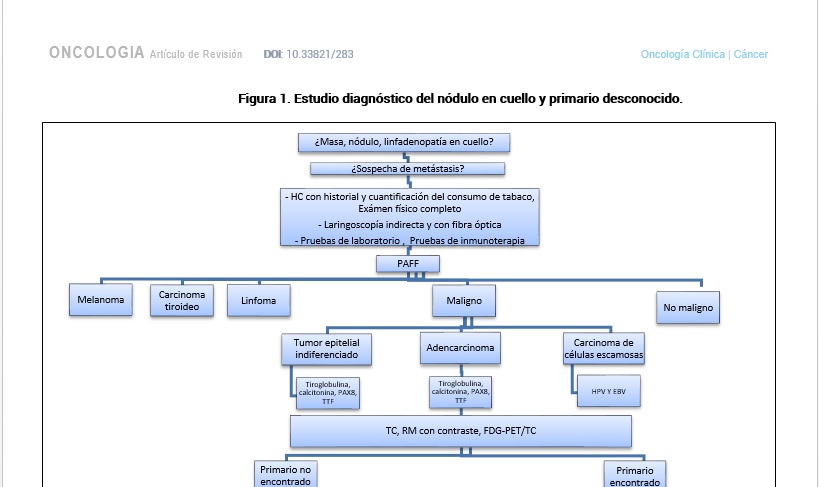
Recent findings: Fine-needle aspiration can differentiate the etiology of neck nodules: melanoma, thyroid carcinoma, lymphoma and other undifferentiated tumors. The measurement of thyroglobulin helps to differentiate a thyroid neoplasm. The affected lymph node level I to III includes the protocol of parathyroidectomy, amigdalectomy. The nodal level IV and V the primary is infraclavicular.
Excerpt: Metastatic cancer of the occult primary is a neoplasm with histological confirmation but with an unknown primary lesion. Its management is controversial and in most cases insufficient to reach the diagnosis, even with autopsy. The initial approach involves a series of laboratory tests and highly complex images that include positron emission tomography with the Flucor 2-Deoxy Glucose test (FDG-PET / CT), pathology studies are the second step within standard handling and include Puncture and Fine Needle Aspiration (FNAP). Traditional microscopy is not enough to identify the primary tumor, immunohistochemical stains although they are not specific or sensitive help with this purpose and even more so electron microscopy. Biopsy or more aggressive procedures such as tonsillectomy are behaviors to follow if the diagnosis has not yet been achieved. A review of the state of the art of metastatic carcinoma of Unknown Head and Neck Primary is presented.


